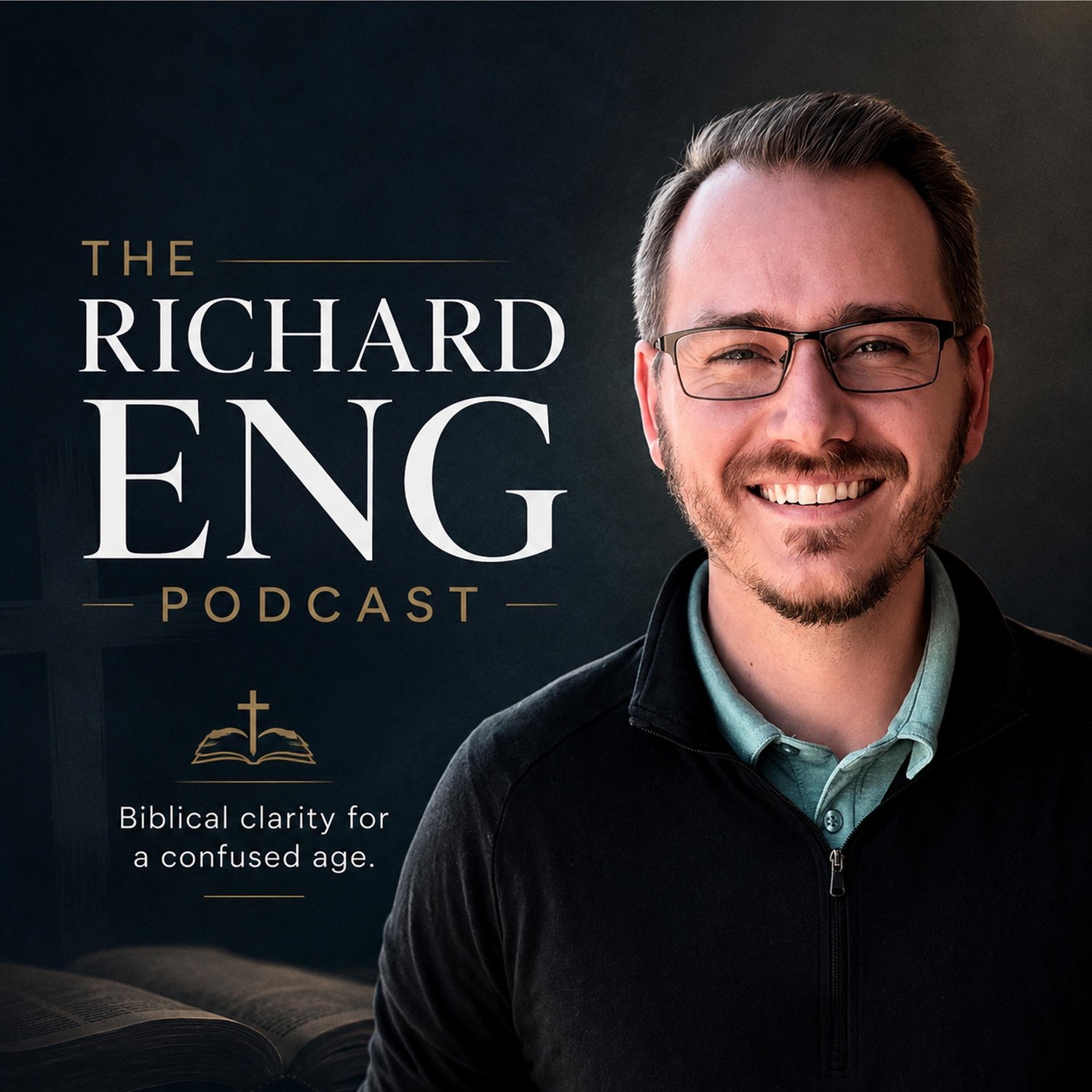
The Richard Eng Podcast
Conversations on Christianity, culture, and apologetics with Richard Eng—lead pastor at Bethel Evangelical Free Church in Devils Lake, ND and author of the children’s book “What Is Heaven Like?”
Episodes
Reading the feed…

Conversations on Christianity, culture, and apologetics with Richard Eng—lead pastor at Bethel Evangelical Free Church in Devils Lake, ND and author of the children’s book “What Is Heaven Like?”
Reading the feed…
What happens behind the scenes when a pastor spends an entire summer preaching through Jesus’ Sermon on the Mount? In this episode, Richard reflects on preparing and preaching Matthew 5–7—from developing ten key concepts that unified the series to making difficult decisions about what belongs in a sermon and what must be left out. He explores different interpretations of the Beatitudes, the Old Testament foundations of Jesus’ teaching, and the linguistic connections that reveal the Sermon on the Mount as one coherent message rather than a collection of disconnected sayings. Richard also shares
Description AI isn’t coming. It’s already here. Artificial intelligence is already shaping how we work, learn, communicate, and even seek advice. So Christians need a better response than either embracing every new tool uncritically or panicking about the future. In this episode, I begin developing a Christian theology of technology. We’ll look at how Scripture presents human creativity, how the fall distorts what we make, and why technology can multiply both good and evil. The goal isn’t to become anti-technology. It’s to use powerful technology without being spiritually formed in its image.
Description How can the church and family work together to make faithful disciples? In this episode of The Richard Eng Podcast, Richard sits down with Zach Davis and Eric Herman for a practical conversation about Christian discipleship, biblical education, parenting, and the local church. They explore what it means for the church to become a hub of Christian education without replacing the family’s essential role. Their conversation covers the importance of forming a biblical worldview from childhood, helping parents become confident disciple-makers, and creating teaching that is both memorabl
Description Christian beliefs do not remain strong through neglect. C. S. Lewis wrote that our beliefs must be fed—a warning that helps explain why some people do not argue their way out of Christianity so much as slowly drift away from it. In this episode, Richard explores how God uses Scripture, worship, Christian community, service, and the repeated practices of the local church to keep truth alive in embodied people. He also examines the competing “feeds” shaping our attention, why online content cannot replace Christian community, how physical spaces support discipleship, and five practic
Description Biblical illiteracy is usually treated like a knowledge problem: Christians don’t know enough Bible stories, doctrines, or verses. But what if the problem goes deeper than that? In this episode, Richard looks at Ephesians 4:17–24 to show why Scripture is not merely giving us information, but renewing the way we see reality. When Christians are not formed by the truth of Christ, they are still being formed by something else. This episode explores why an unrenewed mind cannot produce a faithful walk, why culture is always discipling us, and why learning Christ changes more than what
In this episode of The Richard Eng Podcast, Richard explores one of the most important questions in Christian education and discipleship: if people know more, will they actually become more like Jesus? Scripture gives us a more nuanced answer than many assume. Information alone cannot produce transformation, but transformation requires information. Drawing from James 2, Matthew 7, Romans 12, 1 Corinthians 2, Ephesians 4, and other key passages, Richard explains why biblical knowledge matters, why knowledge by itself is not enough, and why experience must always be grounded in truth. Along the
What is Christian education really for? In this episode of The Richard Eng Podcast, Richard argues that education is never neutral. Every system of education is forming students according to some vision of what is true, what is good, what is beautiful, and what it means to be human. The question is not whether children will be shaped, but who will shape them — and toward what end. Richard explores the difference between education and ideology, showing that true education helps students live according to reality, while ideology reduces reality to a preferred narrative. If Christianity is true,
Why do so many Sunday School programs struggle? It is usually not because churches picked the wrong curriculum. It is because they started with curriculum before clarifying their vision for discipleship. In this episode of The Richard Eng Podcast, Richard explains how to create a successful Sunday School program by starting with clear ministry goals, a systematic teaching plan, and a multi-year discipleship strategy for kids, students, and adults. Rather than chasing the “perfect curriculum,” churches need to ask what kind of Christians they are trying to form. A strong Sunday School ministry
Sunday School didn’t disappear because Christians stopped needing formation. Over the last few decades, church rhythms have thinned, small groups have often replaced classes, and many believers have grown suspicious of knowledge itself—as if information and transformation are enemies. But Scripture never pits teaching against discipleship. We cannot obey what we do not know, and the church cannot form mature Christians without intentional biblical education. In this episode of The Richard Eng Podcast, Richard explores why Sunday School declined and why the local church needs to recover its tea