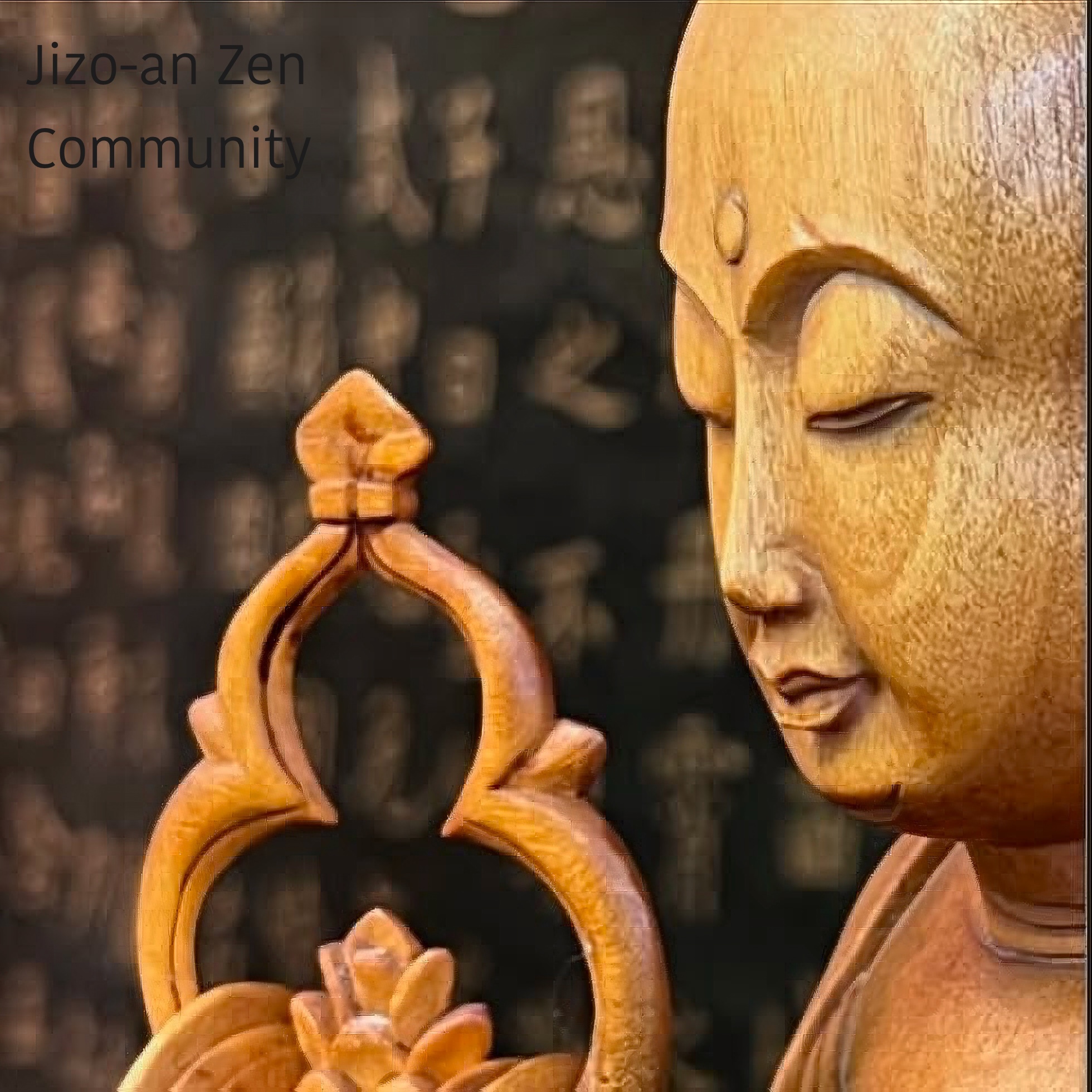
The Jizo-an Zen Community Podcast
Teachings, Dharma talks, Zen studies, and reflections from the Jizo-an Zen Community.
113 episodes
latest
monthly cadence
English language
https://www.jizo-an.org/_functions/podcastFeed
Episodes
Reading the feed…

Teachings, Dharma talks, Zen studies, and reflections from the Jizo-an Zen Community.
Reading the feed…
As we move through this life, we tend to exchange old stories for new ones, but always there is a backdrop of old fears like a shadow that haunts us. In order to fully mature, we need to see through these stories, to identify and come to grips with our maladapted behaviors and strategies. Zen practice helps us to surface our perceived shortcomings, and engage the process of transforming them. We commit to sharing our lives and relationships in more ethical and appropriate ways and behaviors.
In its 2,600-year history, from the time of the Buddha to the present day, Buddhism has grown from a tiny religious community in northern India into a movement that now spans the globe. It has shaped the development of civilizations in India and Southeast Asia and had a major influence on the civilizations of China, Tibet, Korea, and Japan; and today has become a major part of the multi-religious world of Europe and North America. It is a story of the Buddha himself, and the story of generations of people who have used the model of the Buddha's life to shape not only their own but the societie
Studying sutras is one way to awaken this heart/ mind. this big mind as Shunryu Suzuki calls it. And the same goes for our ability to embrace moment to moment awareness.. This moment that is free of description and temptations. In my own practice, the floor has become the greatest anchor…as my eyes fluctuate between closed and partially open the moment I look at the floor, it lifts the haze of the imaginary space, hurling me back to reality. Likewise, when we study sutras as a spiritual practice, the principles of these prayers began to infiltrate our lives and inform us of a different way of
We have largely been conditioned to believe that we need to constantly push ourselves very hard and make strenuous efforts to attain, achieve, or become this or that. We often bring this same mentality to our spiritual practice, believing that we must make strenuous efforts to awaken and realize our true nature. Dogen Zenji described practice as the dharma gate of ease and joy. He emphasized diligent and wholehearted effort, just sitting, not trying to become or attain anything. In Zen, this is often referred to as wise effort or effortless effort. We will examine this dharma gate of ease and
In Zen we are taught that we have everything within us to be awakened and enlightened. However, we, in our conditioned mind, create barriers that hold us back from tapping into our authentic self and to live how we are meant to. How many times do we miss what is right in front of us? How can we see what we need to see? Let us explore these questions and share our lived experiences on this path.
Our lives are constructed of stories. Some are handed down to us, others take form from the outcome of events in our lives. Stories are the stuff of our sense of self, and when habits develop around them, we are constrained, we suffer. To realize new possibilities is how we transform our lives and discover new meaning.
Five years ago, our founder Seijaku Roshi died. As time passes the number of people who actually knew Roshi steadily decreases. But his presence is still here with us and will always be with us. Last year the Jizo-an Zen Community celebrated its 40-year anniversary. There have been a number of changes since Roshi's passing, primarily to make the Dharma available to more people. Roshi had a vision of planting the dharma here in South Jersey. Creating a place where community members, students and monks, could come together to train and realize themselves. Please join the monks as we pay tribute
Paradox is both a powerful word and an important aspect of Zen practice. We often don't feel very comfortable with paradox. We prefer to have our life neatly arranged and packaged. But, Zen points to a very different way of being. The reality is that we live much of our entire life in the midst of paradox. Thich Nhat Hanh taught that life is both terrifying and beautiful all at once. Zen teaches us to embrace this great paradox in our everyday life, and to be fully present for all of it.
Traditionally sangha referred to the community of ordained monks and nuns, but today the term sangha, includes all Buddhist practitioners, lay and ordained. The Buddha taught that each of us is responsible for our own journey of awakening "Be an island unto yourself." But at the same time, the Buddha left us a precious legacy, the teachings (dharma) and the community (sangha). We are never alone if we embrace the three refuges. The existence of Sangha is what makes Buddhism a living, applied spiritual tradition rather than a mere philosophy. We support and are supported by each other.
The "mysterious principle" Master Linji Yixuan (the founder of Rinzai Zen) is centered on direct, spontaneous awareness. He taught us to stop seeking enlightenment outside of ourselves in scriptures, Buddha figures, or even the concept of Nirvana and to recognize our own true unconditioned nature. There is nothing to gain, no path to follow, and nothing special to achieve. True liberation is simply having enough confidence in yourself to stop looking for it and live in awareness as an ordinary person.
Everything we encounter — our bodies, relationships, thoughts, and circumstances, is in constant flux. Yet much of our suffering arises from resisting this truth or attempting to secure what cannot be held. Accepting impermanence opens the door to a more intimate, compassionate, and vivid way of being. Rather than leading to detachment or despair, this intimacy with change allows us to meet each moment with freshness and care—because it will not come again in the same way.
The Heart Sutra, possibly the best known text of Mahayana Buddhism, is said to be the pure distillation of wisdom (prajna). Perhaps because of both its profundity and brevity, the Heart Sutra is the most familiar of all the original teachings of the Buddha. An English translation can easily be printed on one side of a piece of paper. Also the Sino-Japanese version of the Sutra lends itself well to chanting. The Heart Sutra seeks to cut our dualistic thinking at the root.
The Buddha's Noble Eightfold Path begins with Right View or Understanding and Right Intention. Understanding our nature and this Way of Being in the world is essential. But we must go beyond just understanding. We must skillfully apply the practice and live it in our daily life. Our life is our practice - no separation. This is Realization or Actualization. To experience liberation is to bring the teachings to life and make them real, for ourselves and for all beings. To live authentically in the world is to actualize the Dharma in our everyday life. Nothing special, living Zen.
Throughout our lives we experience a wide range of emotions, moods, mind states, and many different physical sensations. Some experiences are pleasant and enjoyable, some are confusing and painful. When considering our own life experiences, or contemplating the world around us, it can be challenging to stay balanced, to be hopeful. We can easily become lost, overwhelmed and depressed. Still, even within the storm, there are ways to build a sanctuary within our inner lives so we can meet life's turbulence with more steadiness and compassion. In Buddhism we find this sanctuary within the Three T
When we embrace a practice like Zen, we realize how difficult it can be to stay on a path that is so radically different from how we have been conditioned to show up. Deep inside, we know that we are not truly being our authentic selves and we consciously decide to search for something that can lead us to be who we naturally are. This practice is not for our personal development or growth. However, that is something that naturally happens. This practice offers the opportunity to show up in the world the way we are truly meant to, and when we do this, we are transformed and liberated.
As human beings, we all wish for happiness and peace in our lives, and we wish not to suffer. Yet, we experience so much sorrow, discontent, and suffering, and we are often left feeling hopeless or helpless, unable to comprehend this suffering. The Buddha's teachings are about liberation from suffering. But what does it really mean to be liberated? Perhaps the fundamental obstacle is that we do not really understand our suffering, nor how to truly cultivate happiness. This evening, we will look at suffering, happiness, peace, and liberation - how to see them more clearly.
The Platform Sutra of Hui-Neng, the sixth patriarch of Chinese Zen is one of the most influential texts of Chan Buddhism. According to Hui-Neng, Buddha nature is the true nature of all beings. We therefore don't need to purify our minds, rather we need to shift our perspective so we can see our true nature. Hui-Neng was an illiterate woodcutter who attained enlightenment, and who went on to demonstrate the depth and clarity of this insight. His example has demonstrated to generations of Zen students and spiritual seekers that awakening is attainable in this lifetime regardless of education or
How can we let go of judgments and self-judgments, living only in the present moment? Can we see this moment as sacred, accepting ourselves and others as they are, accepting and letting go of the past? We're both separate and together, perfect and complete, revealing right here, right now. What are we waiting for? We will examine these questions, these koans together.
Upaya, or skillful means, is a hallmark of not only Zen practice and training, but of the entirety of the Buddha's teachings. How do we live skillfully, moment by moment, in a world on fire, a world with so much division, injustice, and strife? The Buddha's teachings are a prescription for how to liberate ourselves from this pervasive suffering. However, it is not a blanket, one-size-fits-all prescription, but a way of living skillfully with the ever changing circumstances, causes and conditions of life.
In simple terms: we crave more, different and new. When one learns how to 'look' desire is constantly there, knocking and knocking like a sales man who has exactly what you want yet knows you don't need. This seems to be true whether it's for more love or more cars or more fear. The reality is that desire creates this constant conflict within us. This is why most humans breathe very shallowly…like a boa constrictor that's tight enough to hold you down but not tight enough to cut off the flow of air.
Our social contract is based on mutual respect and recognition of our common interest. There are those who have become quite adept at pitting ourselves against ourselves; against each other when we are all truly dependent on each other. There are some who find advantage in focusing on superficial differences rather than our profound shared identity. The Eye of the Heart knows better— we all share a common heritage in the earth, the sea and the stars. We must vow to reinvigorate a view of the sacredness of all things if we are to if we are to survive and even thrive in this life.
Much like creating music, life is of the nature of change and flow. Just as chord changes and progressions constantly create and re-create the flowing rhythms of music, life too unfolds and is constantly in creation according to the ever changing nature of life's flowing rhythms. When we wrestle against that unfolding flow, then life, like music, becomes stagnant and its natural evolution and creative aspect is diminished within us.
In our current state of the world we witness how misinformation spreads like a virus. We witness again and again how easy it is to manipulate others, create division, and spread hatred through wrong speech. In the eight fold noble path the Buddha instructed us on the importance of right speech. When we pay close attention to our words and use them skillfully we can create heaven on Earth. Let us understand and realize the power that lies in the word and how to utilize this power for the benefit of humanity.
"You are Buddha, you are perfect and complete". Most of us would vehemently disagree... for good reason too. We spend lifetimes unconsciously creating fantasies about who we think we are. Just like if you took a dog and trained it to be a killer, there would be no surprise if that were to actually occur. But the dog's true essence is not a killer. We too have 'trained' ourselves to see life through certain filters and so our actions turn out to be direct responses to the distorted lens that we unconsciously created. To understand this, one simply needs a new way of looking. Zazen was created f
Eihei Dogen, the great master of Soto Zen, taught that when we know something intimately, it ceases to exist in the old way and, as a result, so do we. Dogen was a lover of nature. He built his monastery deep in the mountains near streams. In the Mountains and Rivers Sutra he wrote about the mountains and rivers, the wind and clouds, as direct expressions of the great body of the Buddha, the whole earth body as well as your body, and my body. These mountains and rivers of the present are the manifestation of the way of the buddhas and ancient sages. Each abides in its own, dharma state, exhaus