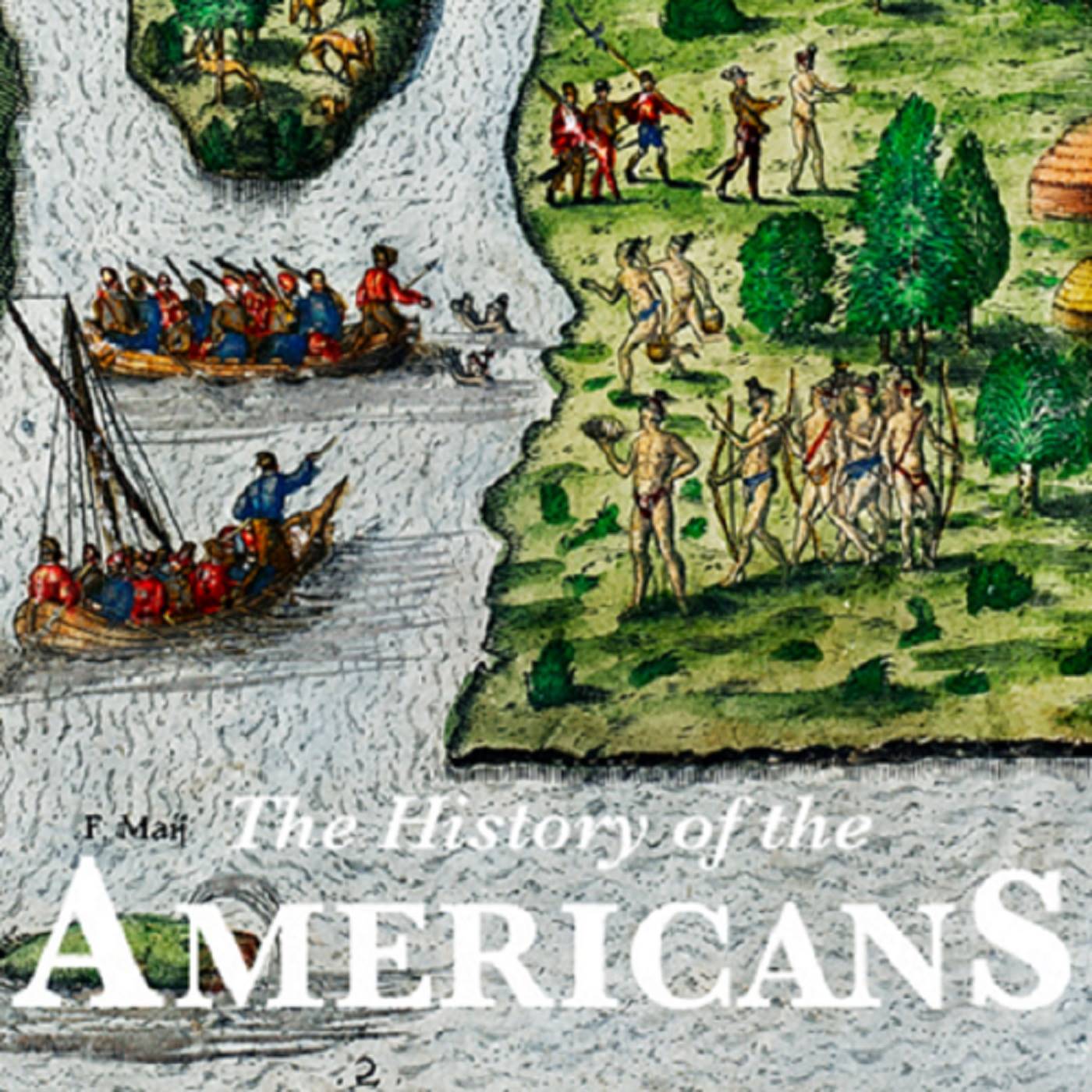
It is time to get back to New France and the exploration of the middle of this beautiful country of ours. Our vehicle will René-Robert Cavelier, Sieur de La Salle, known to both his contemporaries and to history as “La Salle.” You’ve heard his name, especially if you live within driving distance of the Mississippi, but do you know what he actually did? This and the next few episodes tell La Salle’s remarkable story. We are back in New France, along the St. Lawrence River, now in the 1660s. The episode begins with an introduction to the geopolitics of North America from the French perspective,
It is the spring of 1681. The “exclusion crisis,” an insurgency in Parliament proposing to exclude the king’s brother, James, Duke of York, from the line of succession, was reaching its climax. Even so, on March 4 King Charles II found time to grant William Penn a vast territory extending from the west bank of the Delaware River to a longitude equal to the then western border of Maryland. It was now William Penn’s role, as sole proprietor of Pennsylvania, to fill it up with people. He would do a remarkable job, especially under the challenging circumstances, relying heavily on his … pen. Along
With Sir William Penn’s passing in 1671, and his deathbed admonition that his son stay true to himself, young William Penn was both financially independent and liberated from worrying that his own activism on behalf of the Quakers would hurt his family. William now owned lands that generated income of around 2000 pounds a year, or roughly the wages of 100 laborers of the time. Penn was a pious son of privilege who used his social, material, and intellectual advantages to advance his family’s business interests and the interests of Quakers, both as individuals and as a religious community. He w
William Penn returned from Ireland in August 1670, and soon found himself arrested, along with fellow Quaker William Mead, for preaching to a crowd in public in violation of “the common law,” an ambiguity that would play out during their momentous trial. The trial would end in their acquittal, notwithstanding egregious intimidation of the jury by the judge, the Lord Mayor Sir Samuel Starling. Among other exciting moments, Starling threw the principled foreman of the jury, Edward Bushel, in jail. Bushel’s suit for a writ of habeas corpus would lead to a verdict that established an inviolate pri
The purpose of this episode is very simple: If you find yourself driving in your car with others this weekend (or on some future Fourth of July) and you and your passengers – perhaps they are your children and now they are a captive audience at your mercy – might enjoy hearing the Declaration of Independence and knowing just a little bit about the heroic signers of it, play this episode! For those of you too down-to-earth to say “semiquincentennial,” happy 250th Fourth everybody, and please pass this around to anybody who you think might be interested in it. Subscribe to my Substack! X – @TheH
[Announcement: From November 4 through 6, 2026, the Foundation for Individual Rights and Expression (FIRE) is hosting its inaugural Soapbox free speech conference in Philadelphia, the city where so many of America’s defining debates over liberty began. I and the wife of the pod will be there and would love to hoist one with listeners of the History of the Americans. More compellingly, there will be several far more famous podcasters for whom free speech is an important value. Were he able to attend, William Penn would be there too, probably as a keynote speaker. Soapbox will bring together lea
Richard Bell, Rick to his friends and podcast hosts, is Professor of History at the University of Maryland. He is the author of the book Stolen: Five Free Boys Kidnapped into Slavery and their Astonishing Odyssey Home which was a finalist for the George Washington Prize and the Harriet Tubman Prize. He has held major research fellowships at Yale, Cambridge, and the Library of Congress and is the recipient of the National Endowment of the Humanities Public Scholar award and the Andrew Carnegie Fellowship. His new book, The American Revolution and the Fate of the World, published by Penguin, rec
This is the story of the division of the colony of New Jersey into East New Jersey and West New Jersey, and the bizarre legal and financial machinations that resulted ultimately in the settlement of the region by Quakers in the second half of the 1670s. Fundamentally, those machinations were between two somewhat disreputable Quakers, John Fenwick and Edward Byllynge. Their longstanding quarrel would threaten to spill out into non-Quaker circles, so William Penn intervened to arbitrate between them and save the Friends from embarrassment. It was this intervention that would first involve Penn i
The "glorious revolution" of 1688-89 would change the terms of the English monarchy, and reverberate through American history.
Heading as we are into the 1680s on the timeline of the History of the Americans, it will be useful for all of us to know a few basic things about English politics in the 1680s, including especially the “exclusion crisis” of 1679-1681 and the Glorious Revolution of 1688. Both had a big impact on our own history. Along the way we learn more about John Locke, how the acquittal of William Penn transformed the law in England and ultimately the United States, the actual conspiracy between the English King Charles II and Louis XIV of France, the origin of the words “Tory” and “Whig” at the moment th
Going down a rabbit hole while learning about the Pueblo Revolt of 1680, I started reading about something I have wondered about – how and when did the Indians of the American West acquire horses and learn to use them rather than eat them? The answer is not what you think, or at least not what I thought before I did this work. The story begins with the discovery of silver in Mexico, which I did not see coming. Subscribe to my Substack! X – @TheHistoryOfTh2 – https://x.com/TheHistoryOfTh2 Facebook – https://www.facebook.com/HistoryOfTheAmericans Primary references for this episode William Taylo
It is August, 1680 in New Mexico. The rebelling Pueblo Indians have sprung their ambush and quickly killed 400 Spaniards. About 2500 survivors have concentrated in two groups, at the government buildings in Santa Fe, and 70 miles to the south at Isleta Pueblo. Each has reason to believe that everybody else has died, and they are alone. The Indians beseige Santa Fe, but Governor Antonio de Otermín leads a successful defense. Still, they are isolated and out of food, and determine to retreat to the recently established mission at El Paso. The southern group, under Lieutenant Garcia at Isleta, ma
In August 1680, an alliance of Puebloan peoples, led by a mysterious religious man named Po'pay (also spelled Popé), launched a surprise attack that forced the Spanish entirely out of New Mexico 82 years after they had first settled it. Po'pay’s rebellion would combine elements that will remind longstanding listeners of King Philip’s War in New England and Opechancanough’s surprise attack in Virginia in March 1622. Unlike the Wampanoags and the Pamunkeys, however, Po'pay would achieve his war aims. Along the way we examine the causes of the revolt, the preparations for the ambush, and the terr
In 1677, the longtime residents of the old and remote county of Albemarle in northern Carolina, a collection of cranks and dissidents who had fled from Maryland and Virginia and were used to living free of interference from the Carolina proprietors and the Crown's tax collectors, revolted against new attempts to collect duties on tobacco. Quite astonishingly, they succeeded! And not without some history comedy along the way. In the long history of the Americans, it is easy to ignore Culpeper’s Rebellion. Virtually all surveys of American history do. Albemarle was small, a literal backwater, an
Twenty-five year-old bookseller Henry Knox, his 19 year-old brother Will, and teamsters led by John Becker, Sr., move a long "noble train" of 59 pieces of salvaged artillery from Fort Ticonderoga to Cambridge. The route crossed frozen rivers and the not-dreamlike Berkshire Mountains under unbelievably arduous conditions. As word spread, crowds of Americans would turn out to cheer them on, and serve them cider and whiskey. The artillery, when hoisted to the commanding heights of Dorchester above Boston, would drive the British from their long occupation of that city, and they would never return
Exactly 250 years ago, a rotund twenty-five year-old Boston bookseller named Henry Knox was riding his horse between Springfield and Worcester Massachusetts, on his way to George Washington’s headquarters in Cambridge. Washington’s ragtag, ill-equipped Continental Army had kept the British garrison under General Thomas Gage bottled up in Boston and Charlestown since the summer of 1675. Washington had a whole load of problems, including insufficient arms for his men, many with expiring enlistments that threatened to shrink his force by half or more. He also had almost no artillery, just 12 smal
In the last episode on the Timeline, “Bacon’s Aftermath 1: Diplomacy and Conspiracy 1677-1685,” we looked at the political and geopolitical aftermath of Bacon’s Rebellion. This time we tackle the changes inside Virginia’s society and economy in the years following Bacon’s Rebellion, some of which may have been because of the Rebellion, and others of which probably would have happened anyway. The first half of the episode looks at the governorship of Thomas, Lord Culpeper, and his deft efforts to give effect to the Crown's desire “to substitute the benevolent despotism of the king for the rapac
Matthew Restall is an historian and author of over forty books, focusing on the Spanish Conquest era in the Americas; on Aztec and Maya history; on the history of colonial Mesoamerica, primarily Yucatan but including Mexico, Guatemala, and Belize; on the historical African diaspora in the Americas; and on the history of popular music. Matthew is most recently the author of The Nine Lives of Christopher Columbus, the topic of and inspiration for this conversation. Finally, he is Edwin Erle Sparks Professor of History and Anthropology, and Director of Latin American Studies, at Pennsylvania Stat
This episode looks again at the causes of Bacon's Rebellion in light of what we have now learned, before turning to the region of the Chesapeake in the years after the Rebellion. There are two big themes in the post-Bacon Chesapeake. The first, the subject of this episode, is geopolitical. After Bacon, what changed in intercolonial affairs, in the relationship between the Chesapeake colonies and England, and between those colonies and the indigenous nations? The second theme, for part 2, is essentially domestic. How did Virginia itself change politically, economically, and socially, with a spe
It is late January 1677 in Virginia. Loyalists under the command of Governor Sir William Berkeley had suppressed Bacon's Rebellion just after New Year. Now Berkeley was prosecuting the surviving leaders of the rebellion, and loyalist units were looting the estates of wealthy Baconistas to recover losses they had suffered during the war. Then a fleet from London materialized at the mouth of the James, carrying three royal commissioners and a thousand "red coats," English regular infantry. Their mission, per Charles II, was to suppress the rebellion - which Berkeley and his supporters had alread
Last episode ended with Sir William Berkeley, on the deck of a ship in the James, watching Jamestown burn to the ground in the wee hours of September 19, 1676. The rebels under Nathaniel Bacon were ascendant, and Berkeley resolved to return to his refuge on the Eastern Shore and plot the next phase of his increasingly desperate war. Little did he know that the tide of the war was about to turn again in his favor. This episode begins in London in the summer of 1676, where Crown officials were just beginning to figure out what to do about the turmoil in Virginia, over which they had incomplete a
Virginia Governor Sir William Berkeley has fled to the Eastern Shore with a small group of loyalist planters and a detachment of perhaps only fifty armed men. Nathaniel Bacon has occupied Berkeley's estate near Jamestown, and dispatched men to capture loyalist ships anchored there. Bacon's "navy" has out in search of Berkeley, but Berkeley turned the tables in an audacious amphibious attack and grabbed control of the Bay and the rivers. While Bacon was mucking around in the Dragon Swamp hunting notionally allied Pamunkeys, Berkeley recaptured Jamestown. Loyalist victory seemed at hand, but Bac
Nathaniel Bacon and his army of volunteers have returned from beating up on the friendly Occaneechees (Occaneechis) on the Roanoke River in southern Virginia. It is election day, and Henrico County will elect Bacon and his sidekick, James Crews, to the Virginia Assembly, which has been called into session on June 5, 1676. This episode describes the dramatic session of that Assembly, which began with Bacon's arrest and ended with he and his army holding the Assembly at gunpoint. Sir William Berkeley, governor of Virginia, demonstrates his own flair for the dramatic along the way, but by the end
The Susquehannocks, having successfully escaped from their beseiged fort on Piscataway Creek in Maryland, fled through the Virginia Piedmont to set up winter quarters on the James and Roanoke Rivers. In January 1676, they launched a measured counterattack. The settlers on the frontier panicked and evacuated. Rumors of war spread. The horrors of King Philip's War loomed large, especially in the thinking of Sir William Berkeley, the governor. A fundamental debate over how to respond to those Susquehannock attacks set up the confrontation between Nathaniel Bacon and his populist - and it should b
The year is 1675, and we are in Virginia. All kinds of social, demographic, fiscal, and economic pressures have been building for decades, and the common people are restive. There have been a string of small revolts and disruptions in the years since 1660, but they all failed for lack of effective leadership. The "masterless men" in the colony needed a leader, and the leader, when he arose, would need a cause. Nathaniel Bacon, a ne'er do well son of a wealthy gentleman in English, would be that leader. He arrived in Virginia in 1674 with a fat bankroll, sent there by his father after he got in