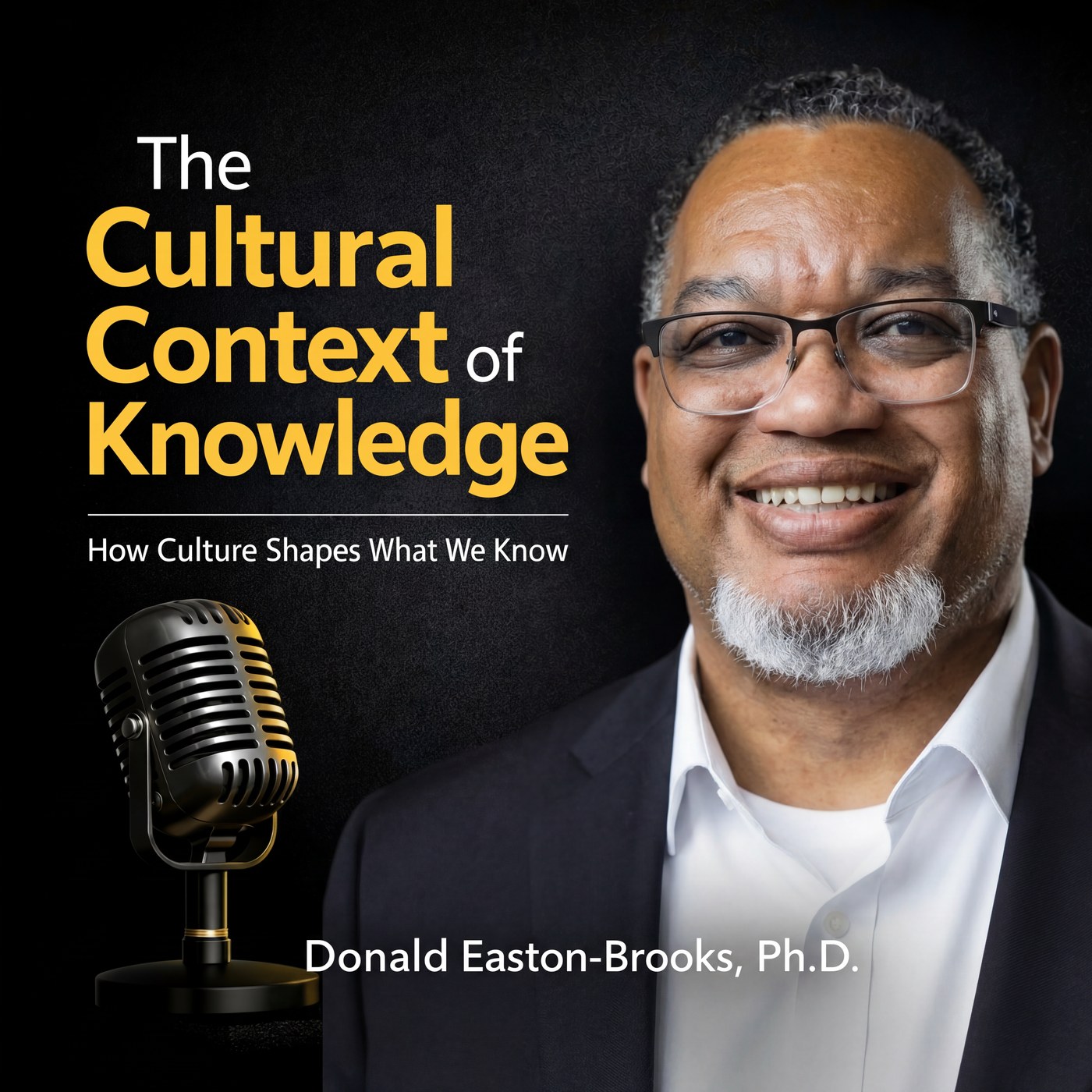
Dr. Donald Easton-Brooks on how schools decide whose knowledge counts. Researched, single-voice essays on curriculum, pedagogy, equity, and the cultural context of learning. A companion to donaldeastonbrooks.com.
What the Communities Already Knew: Research, Method, and the Road Ahead (S3 E11)
· 21:16
The season finale looks underneath the whole argument, at the research itself. Dr. Easton-Brooks traces how the evidence for ethnic matching got built, the qualitative scholars who recorded what communities already knew and the quantitative studies that gave it scale, and shows the two did not compete but depended on each other. He carries the season's missing column from the old datasets into the software researchers use now, where silently dropped rows can turn a study of everyone into a study of whoever trusted the survey. He walks through the tools he worked on with ReliCheck, Quanta, Qual
Beyond the Schoolhouse Door: Ethnic Matching in Higher Education (S3 E10)
· 15:01
For nine episodes this season, ethnic matching stayed inside the PK through 12 classroom. This one steps past the schoolhouse door into higher education, where access is no longer the main barrier and the real work is belonging and cultural responsiveness. Dr. Easton-Brooks returns to the demographic wave he charted in 2009, now arrived: for the first time in United States history, more than half the population under twenty-one is People of Color. He lays out three pillars of matching in colleges and universities, classroom instruction, academic advisement, and faculty mentorship, then names t
From Research to Policy: Pathways That Worked, and Why Most Didn't (S3 E9)
· 18:02
The case for ethnic matching was built across three decades. This episode asks the question deferred just as long: what does it actually take to turn that research into policy that lasts? Dr. Easton-Brooks walks through the workforce gap that has not closed, the three structural barriers that keep it open, and the four models that have worked, from Grow Your Own programs and paid residencies to Minority Serving Institution partnerships and retention reform, naming the scholars and practitioners behind each. He draws the line between aspiration and infrastructure, sets the post-Brown displaceme
Where Is the Data: The Quantitative Wave (S3 E8)
· 30:27
A doctoral student sits in the back of a Denver board meeting and watches the whole season come to a point in about nine seconds. Community representatives present the findings of the scholars he has spent years reading. A board member leans forward and asks, where is the data. A presenter answers, this is the data. The board member says, where are the numbers. Then silence. Dr. Easton-Brooks has carried that silence for more than twenty-five years, and this episode comes out of it. Between 2000 and 2025 a generation of researchers put a number on what the storytellers had already proven, a nu
The Research Comes Home: The Qualitative Turn (1980 to 2000)
· 22:20
In 1966 the Coleman Report measured six hundred thousand children and, for all its reach, missed the ones it claimed to see. It studied children of color with instruments built by people who had never lived their lives, then wrote its findings in the language of numbers, as if numbers were neutral. A generation of scholars of color read that report and reached a hard conclusion: the data did not fit their communities, so the numbers could not be trusted to tell the story. Between 1980 and 2000, across Black, Mexican American, Indigenous, and Asian American communities at once, they put the sur
The Chair Was Full: A Lived History (1960 to 1980)
· 18:39
They came to measure children like me, and they could not see the one thing that was carrying us. Dr. Easton-Brooks was born in 1964 and grew up in Texas schools where nearly every teacher at the front of the classroom was Black, from his own neighborhood, and knew his family before he said a word. He had the match. For five episodes, this season told other people's history. This time the story arrives at the host's own doorstep, in the exact years he lived, 1960 to 1980. While he was quietly handed the thing other communities were fighting for, the country was on fire over it: the Little Rock
What Winning Cost
· 28:39
In the spring of 1951, a sixteen-year-old named Barbara Rose Johns, tired of being taught in a tar-paper shack, led four hundred and fifty classmates onto a picket line. That walkout became one of the five cases the Supreme Court joined together as Brown v. Board of Education. A child started it. This episode holds two truths at once. First, the long road to Brown, walked at the same time by Mexican, Japanese, Native, and Black families: Sylvia Mendez and the LULAC cases that shaped the brief Thurgood Marshall carried into Brown; Japanese families teaching their own children inside incarcerati
The Lie in the Lesson
· 33:44
Somewhere around 1930, a child sat in a classroom and learned to be ashamed of her own grandmother. Between 1921 and 1940, the harm of the official school was finally named out loud, and the lesson itself had become the weapon: a history book that erased the child, a separate room that called her Spanish a deficit, a federal curriculum built to scrub a Native nation out of a child, a classroom where no adult could speak her language. Carter G. Woodson gave the harm its sharpest name in The Mis-Education of the Negro. But in those same years, a teacher, a scholar, an advocate, a lawyer stepped
The Schools Built Against Them
· 21:00
Between 1890 and 1920, families across Black, Native, Mexican, Chinese, and Japanese communities learned the same lesson: the public school did not mean the same thing for every child. A separate school with fewer dollars and a shorter term. Removal from family, language, and ceremony. Sorting called language help. Belonging that could swing on the politics of the moment. This episode stays inside what those families knew before any court, study, or official named it, and on what they built beside the public system so their children would have one place that began with them whole. From the Hop
The Teacher They Built
· 16:52
Picture four teachers, in the same country, in the same years before the Civil War. They never meet. They speak four different languages. And without knowing it, each one makes the same decision. In St. Louis, a formerly enslaved Black minister teaches children in a church basement. In a Southwest parish, a teacher holds a classroom in Spanish for Mexican children. On the California coast, Chinese families fund a school for the children the public system locked out. And in the Cherokee Nation, teachers educate children in Cherokee. This episode tells those four histories together, the way they
The Inheritance Tax Intro: Where Ethnic Matching Became
· 14:57
Season 3 opens. Dr. Donald Easton-Brooks names the season — The Inheritance Tax: Where Ethnic Matching Became — and walks listeners into the history before the history. Long before the research field had a term for it, Black, Native, Latino, and Asian communities in the U.S. were already practicing what scholars would later call ethnic matching. This season traces a 130-year practice across four communities and asks what schools owe the inheritance they have been interrupting. Join the email list for the show notes, the full reference list, and the written companion to every episode, plus the
Season 3 Trailer: Ethnic Matching: What Forty Years of Research Already Knows
· 3:29
Season 3 of The Cultural Context of Knowledge takes up ethnic matching: the research that asks what happens to students, especially Black, Latino, and Indigenous students, when the teacher in front of them shares aspects of their cultural background. Twelve episodes. One through-line. Forty years of evidence on how matched and unmatched classrooms produce different outcomes, why the teaching workforce is shaped the way it is, and what districts have tried. Join the email list for the show notes, the full reference list, and the written companion to every episode, plus the series reading list t
Will Education Pivot With It?: Designing for the World That Already Exists
· 15:39
We opened this season with a question. The demographic pivot has already happened. Will education pivot with it? After nine episodes describing the architecture — institutions, laws, the hidden curriculum, AI, standards-setting, assessment — the season closes by returning to the classroom we walked into in Episode 1. Same building. Same children. Same teacher. The classroom has not changed. We have. This finale synthesizes the season's argument and names the lever the next season takes up: the teacher at the front of the classroom. Join the email list for the show notes, the full reference lis
When Assessment Becomes Gatekeeping: An Instrument That Was Never Calibrated Against You
· 18:46
Two students take the same standardized reading test. Question fourteen is about a regatta, a sailing race. The first student has been to the harbor every summer of her life. The second has never seen a regatta. The test reports the first student as a stronger reader. What the test measured was not reading comprehension. It was access to a particular cultural setting. This episode names the standardized test as the closing instrument of the legitimacy machine, names curriculum and assessment as a pair, and asks what an accountable assessment system would actually look like. Join the email list
How State Standards Get Written: Curriculum as Compromise
· 17:51
State standards are the most concentrated place in U.S. public education where decisions about other people's children get made by people who do not have to live with the consequences. This episode names curriculum as compromise, asks who is at the table when standards get written, and sketches what an accountable standards process — with community elders, classroom teachers, and learners as voting members — could look like. Join the email list for the show notes, the full reference list, and the written companion to every episode, plus the series reading list to start: https://podcast.donalde
AI as the New Gatekeeper: Whose Knowledge the Model Was Built to See
· 17:55
The newest gatekeeper between learners and what they are trying to know is a model that fills silence with fluent invention. This episode names confabulation as a patterned harm — the model is most confident about exactly the knowledge traditions the written record under-represents — and asks what culturally responsive AI accountability, drawing on Ladson-Billings, Gay, Paris, and the CARE Principles, would actually require. Join the email list for the show notes, the full reference list, and the written companion to every episode, plus the series reading list to start: https://podcast.donalde
The Hidden Curriculum: When Researchers Chose the Word Violence
· 15:21
Some words are not just names — they are arguments. This episode examines how researchers came to use "violence" to describe certain institutional practices in education, and what that conceptual shift reveals about adultification, developmental harm, and the unwritten rules children of color meet in kindergarten classrooms long before they meet a textbook. Join the email list for the show notes, the full reference list, and the written companion to every episode, plus the series reading list to start: https://podcast.donaldeastonbrooks.com/subscribe?from=podcast
The Backlash: Why Newly Legitimate Knowledge Gets Targeted
· 10:27
Marginalized knowledge does not stay marginalized, and it does not stay curricular either. This episode names the three-move cycle — dismissal, absorption, restriction — that dominant knowledge systems run when bodies of knowledge from the margin reach the record, and traces its most recent appearance in the wave of state-level curriculum laws since 2020. Join the email list for the show notes, the full reference list, and the written companion to every episode, plus the series reading list to start: https://podcast.donaldeastonbrooks.com/subscribe?from=podcast
Who Gets to Teach It? Representation and the Long Shadow of Brown v. Board
· 11:15
Integration happened to the students — it did not happen to the teaching profession. Revisits the Brown v. Board–era displacement of Black educators rarely included in the standard story, and examines what decades of research on ethnic matching reveal about student outcomes. Join the email list for the show notes, the full reference list, and the written companion to every episode, plus the series reading list to start: https://podcast.donaldeastonbrooks.com/subscribe?from=podcast
From Knowledge to Legitimacy: How Institutions Decide What Counts
· 12:54
How do ideas become legitimate knowledge? Drawing on Foucault, Kuhn, Merton, and Bourdieu, this episode examines how universities, journals, and academic institutions decide what counts as credible through power and gatekeeping. Join the email list for the show notes, the full reference list, and the written companion to every episode, plus the series reading list to start: https://podcast.donaldeastonbrooks.com/subscribe?from=podcast
Why Some Knowledge Is Marginalized: The Evolution of Ethnic Studies
· 13:22
Explores the history of ethnic studies and how student movements challenged universities to recognize marginalized histories and perspectives — and how expanding participation reshapes the boundaries of legitimate knowledge. Join the email list for the show notes, the full reference list, and the written companion to every episode, plus the series reading list to start: https://podcast.donaldeastonbrooks.com/subscribe?from=podcast
Knowledge, Power, and the U.S. Demographic Pivot
· 7:55
The classroom has changed — has education? For the first time in U.S. history, children under 18 are the majority non-white. Season 2 opens with the question: who decides what counts as knowledge? Join the email list for the show notes, the full reference list, and the written companion to every episode, plus the series reading list to start: https://podcast.donaldeastonbrooks.com/subscribe?from=podcast
From Studying to Transfer, Confidence, and Long-Term Growth (Learner Edition, S1 E11)
· 9:09
Closing the seven-part series: how to move beyond short-term studying and build learning that transfers across new classes, new problems, and real-life decision-making. Join the email list for the show notes, the full reference list, and the written companion to every episode, plus the series reading list to start: https://podcast.donaldeastonbrooks.com/subscribe?from=podcast
How Your Brain Makes Room for New Information (Learner Edition, S1 E5)
· 17:57
Why learning naturally feels difficult — and why that struggle is not a sign something is wrong with you. A 'mental storage room' metaphor opens the seven-part Learner Edition series. Join the email list for the show notes, the full reference list, and the written companion to every episode, plus the series reading list to start: https://podcast.donaldeastonbrooks.com/subscribe?from=podcast
Memorization vs. Learning: How to Make Studying Actually Stick (Learner Edition, S1 E6)
· 9:03
Studying as memorization leaves information that disappears on tests or can't be used in real problems. Breaks down the difference between memorizing and learning so what you study actually sticks. Join the email list for the show notes, the full reference list, and the written companion to every episode, plus the series reading list to start: https://podcast.donaldeastonbrooks.com/subscribe?from=podcast